NEWS
🔥 BATTLE LINES DRAWN: Capitol Hill Goes DARK — And the Stakes Have Never Been Higher 🔥 Capitol Hill is officially a ghost town. The House and Senate are out of session until early next year, and Washington has gone quiet — but don’t be fooled. This silence is loaded with tension. Lawmakers packed their bags and left town before Christmas, abandoning several explosive issues that could reshape the political and economic landscape the moment they return. And now? The clock is ticking. ⏳ ⚠️ What Did Congress Leave Behind? While Americans focus on the holidays, unfinished business is piling up: 👉 Long-term government funding remains unresolved 👉 The future of Obamacare is still hanging in the balance 👉 Partisan divisions are deepening, not cooling 👉 Any delay raises the risk of shutdowns, market instability, and policy chaos This isn’t a break — it’s a strategic pause before political warfare resumes. 🧠 Why This Matters to YOU When lawmakers walk away without solutions: Federal agencies face uncertainty Healthcare coverage for millions is at risk Markets brace for instability Everyday Americans pay the price for political gridlock Behind closed doors, battle lines are being drawn. When Congress reconvenes, compromise may be off the table — and confrontation may take center stage. ❓ Key Question: When lawmakers return next year… Will they govern — or will they gamble with the country’s future? 💬 JOIN THE CONVERSATION 🗣️ Do you think Congress is dodging responsibility? 🗣️ Should healthcare reform and government funding be non-negotiable priorities? 🗣️ What’s the real cost of legislative delay? Drop your thoughts in the comments 👇 Tag someone who needs to see this 👀 Share this post to keep the pressure on 🔁 🔗 READ MORE & STAY INFORMED: 👉 Click here for the full breakdown and updates 📌 Don’t scroll past this. 📌 Don’t stay silent. 📌 Accountability starts with awareness. The fight isn’t over — it’s just getting started. 💥

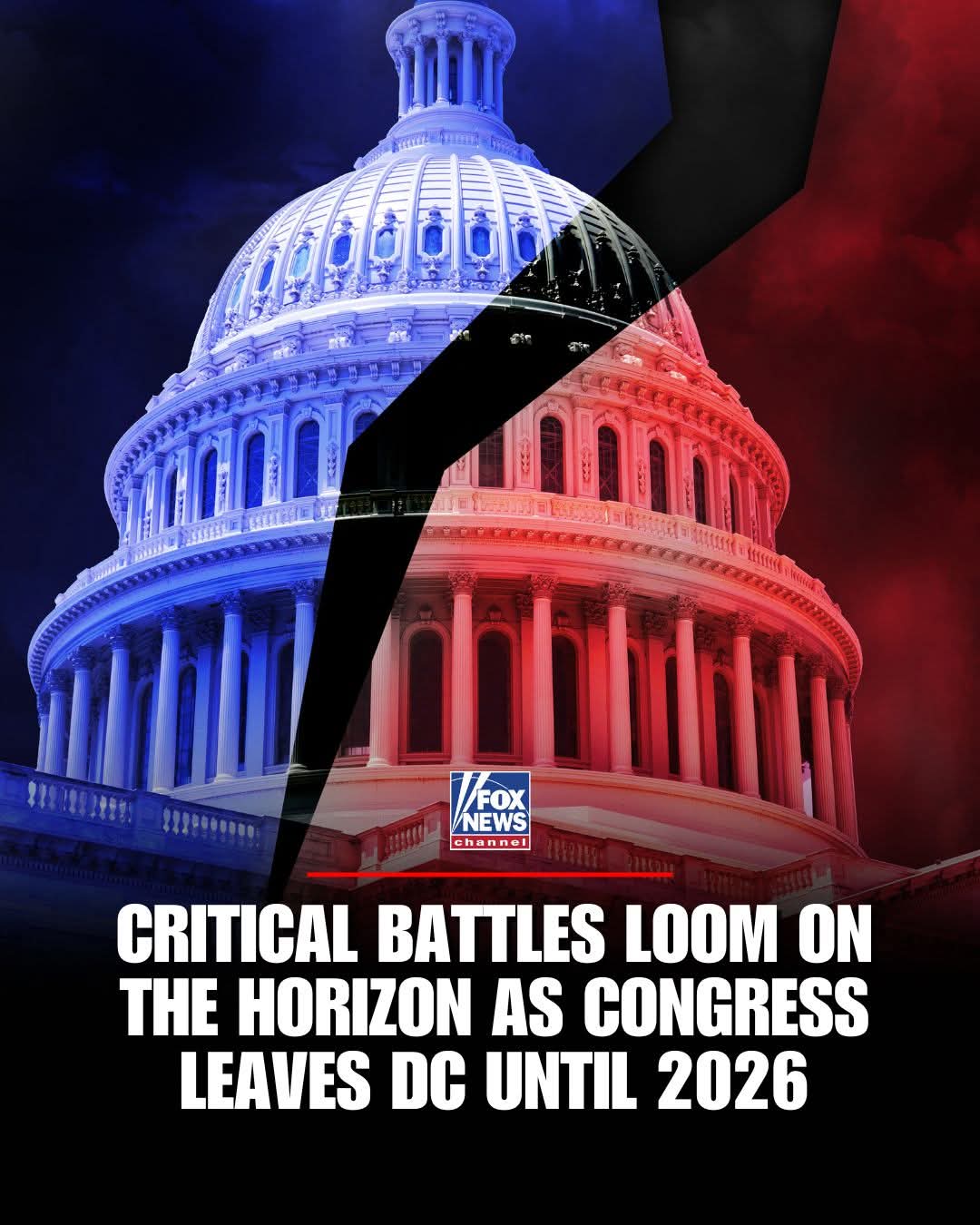
BATTLE LINES DRAWN: A Silent Capitol, Unfinished Fights, and a Nation Left Waiting
Capitol Hill has gone quiet — eerily quiet.
The marble hallways of Congress are empty. The lights in committee rooms are dim. The microphones that usually carry fiery speeches and partisan clashes have gone silent. With both the House of Representatives and the Senate out of session until early next year, Washington, D.C. feels less like the center of American democracy and more like a political ghost town.
But make no mistake: this silence is not peace.
It is tension.
Lawmakers left town the week before Christmas, heading home for the holidays while leaving behind some of the most consequential and unresolved fights in modern American politics. The problems didn’t disappear when Congress adjourned — they simply followed the country into the new year, growing heavier by the day.
At stake are issues that affect every American household: long-term government funding, the stability of federal agencies, and the future of Obamacare — a healthcare law that millions rely on for coverage, medication, and financial survival.
This is not just a legislative pause.
It is a moment of reckoning.
A Holiday Exit With High Stakes
Congressional recesses are nothing new. Lawmakers have always stepped away for holidays, campaigns, and district work. But what makes this departure different is what was left undone.
Before Christmas, Washington faced a clear choice:
Stay in session and resolve critical issues, or
Leave town and push the hardest decisions into the future
Lawmakers chose the second option.
Instead of finalizing a long-term funding plan for the government, Congress postponed the fight. Instead of providing clarity on healthcare policy, lawmakers left millions of Americans guessing. Instead of lowering the political temperature, they walked away while divisions hardened.
For many Americans, this decision felt less like a break and more like abandonment.
The Government Funding Time Bomb
At the center of the unresolved agenda is long-term government funding.
Without a clear funding agreement, federal agencies operate under temporary measures that create instability and inefficiency. Workers face uncertainty about paychecks. Programs struggle to plan for the future. Critical services operate under the constant threat of disruption.
Government shutdowns are no longer rare events — they have become political weapons. Each unresolved funding fight raises the same fears:
Will federal employees be furloughed?
Will essential services be interrupted?
Will political brinkmanship once again override public interest?
Every delay increases the risk. And with Congress out of town, there is no negotiating table, no votes, no solutions — only waiting.
Obamacare: A Fight That Never Ended
Equally unresolved is the future of Obamacare, formally known as the Affordable Care Act.
More than a decade after its passage, Obamacare remains one of the most polarizing laws in American history. For supporters, it represents expanded coverage, protections for preexisting conditions, and a lifeline for millions. For critics, it symbolizes government overreach, rising costs, and bureaucratic complexity.
What is undeniable is this: millions of Americans depend on it.
Yet Congress left town without answering fundamental questions:
Will funding levels remain stable?
Will key provisions be weakened, repealed, or expanded?
Will healthcare costs rise or fall in the coming year?
For families relying on subsidies, prescription coverage, or Medicaid expansion, this uncertainty is not abstract — it is personal.
Healthcare decisions cannot be put on pause, even when Congress chooses to.
Political Strategy or Political Failure?
Supporters of the congressional recess argue that lawmakers need time to consult constituents, reflect, and prepare for the battles ahead. Critics see something far less charitable: political avoidance.
By leaving town, lawmakers temporarily escape:
Tough votes
Public scrutiny
Accountability for inaction
But the problems do not stay behind. They follow Americans into the new year, affecting budgets, health decisions, and confidence in government.
This raises a troubling question:
Is gridlock now the default setting of American governance?
When Congress repeatedly delays decisions that directly impact the public, trust erodes. Cynicism grows.
And the belief that Washington no longer works for ordinary people becomes harder to dismiss.
A Divided Congress, A Divided Nation
The unfinished business on Capitol Hill reflects a deeper reality: America is politically divided, and Congress mirrors that division.
Partisan lines are sharper than ever. Compromise is often portrayed as weakness. Cooperation is rare, and ideological purity tests dominate party politics.
In this environment, even routine governance — funding the government, maintaining healthcare programs — becomes a battlefield.
The result is a cycle:
Deadlock
Delay
Public frustration
More polarization
And the cycle repeats.
The Cost of Waiting
Every day Congress remains out of session without solutions carries real consequences:
Federal workers live with uncertainty
Healthcare providers struggle to plan
States and agencies delay investments
Citizens lose faith in democratic institutions
This is the hidden cost of inaction — not measured in headlines, but in stress, instability, and diminished trust.
The question is no longer whether these issues will resurface when Congress returns. They will. The question is how explosive the confrontation will be.
What Happens When Congress Returns?
When lawmakers reconvene early next year, they will face the same issues — only with less time and more pressure.
Will Congress:
Seek bipartisan compromise?
Push through partisan agendas?
Use shutdown threats as leverage once again?
The coming weeks could define the political tone for the entire year ahead.
This is where the real battle begins.
Why Public Attention Matters Now
Silence benefits those who prefer delay. Public attention changes that equation.
History shows that sustained public pressure:
Forces lawmakers back to the table
Shapes media narratives
Influences legislative outcomes
This moment — while Congress is absent — is when citizens must be most engaged.
The Bigger Picture
This is about more than funding bills or healthcare policy.
It is about whether American democracy can still deliver solutions in an era of deep division.
Can elected officials govern responsibly when the cameras are off?
Can compromise still exist without being labeled betrayal?
Can public needs outweigh partisan strategy?
These questions will define not just the next legislative session, but the future of governance itself.
Final Thought: Silence Is Not Neutral
A quiet Capitol Hill does not mean nothing is happening. It means decisions are being postponed, stakes are rising, and the consequences are accumulating.
The battle lines are drawn.
The pause is temporary.
And when Congress returns, the clash will be unavoidable.


BREAKING NEWS: Do Americans Approve of Trump’s Way of Ruling? Public Opinion Splits as Debate Over His Leadership Style Resurfaces

‘WE GOT HIM!’: President Trump announced on Truth Social that U.S. forces carried out one of the most daring search-and-rescue missions in history, successfully recovering a senior officer who had been behind enemy lines in Iran.

“Andy Reid: ‘I Would Never Bet Against’ Patrick Mahomes Returning for Week 1 of 2026 Season”

Serena Williams shares a deep message for fans worldwide… Now people everywhere are reacting in a big way….

BREAKING: Trump Fires Attorney General Pam Bondi in Major Cabinet Shakeup Amid Iran War Tensions

See Serena Williams in Spicy Wet Red Barely-There Never-Before-Seen Mouth-Watering Photos: Fans Lose It When the Red Dress Couldn’t Hold Her Melons and Dropped and Revealed Her Giant…

See Serena Williams in Spicy Wet Red Barely-There Never-Before-Seen Mouth-Watering Photos: Fans Lose It When the Red Dress Couldn’t Hold Her Melons and Dropped and Revealed Her Giant…

The Goat ! Serena Williams at the vanity fair Oscar party …..

Fans have to check in : New 17 Serena Williams hot bikinis pictures
Hot Serena Williams bikini photos: 🎾 Serena Williams is embracing her new look and shutting down the noise. The tennis legend recently shared photos in bikinis

Fans Weren’t Ready for What Serena Williams Revealed While Trying on a Bikini in Her Wardrobe…