NEWS
🚢⚡ HISTORY MADE: Australia Just Launched the World’s Largest Battery-Electric Ship — and It Was Built in Tasmania What if the future of clean transport wasn’t a promise… but a floating, fully operational reality? That future just left the dock in Hobart. Australia has officially launched the largest battery-electric ship ever built, a 130-metre maritime giant known as Hull 096 (soon to be named China Zorrilla). And this isn’t a prototype. This isn’t a concept sketch. This is commercial-scale, zero-emissions transport, built right here in Tasmania and ready to sail the world. 🌍⚡ 🔋 A Floating Powerhouse — By the Numbers Let these figures sink in: • 130 metres long — larger than most conventional ferries • 2,100 passengers and 225 vehicles capacity • Over 250 tonnes of batteries • More than 40 megawatt-hours of energy storage • Zero diesel engines • Zero exhaust emissions This is now the largest maritime battery system ever installed on a vessel — anywhere on Earth. No smoke. No fuel spills. No compromise on performance. ⚙️ Tested, Powered, and Moving Forward The ship has already been powered up and tested on Hobart’s River Derwent, proving its capabilities in real-world conditions. It’s now preparing for final sea trials before being delivered overseas — carrying Australian engineering excellence across international waters. This is not a “someday” project. This is built, tested, and happening now. 🌏 Why This Changes Everything Shipping accounts for nearly 3% of global emissions — more than aviation. For decades, the industry has been labeled “too hard to decarbonize.” Tasmania just proved that narrative wrong. This vessel shows the world that: ✅ Large-scale electric ships are viable ✅ Clean transport can outperform legacy systems ✅ Australia can lead — not follow — the global energy transition From shipyards to sea lanes, Australian innovation is setting the global standard. 🇦🇺 Built in Tasmania. Ready for the World. This is more than a ship — it’s a signal. A signal that clean energy jobs, advanced manufacturing, and export-ready innovation can thrive in Australia. A signal that regional Australia can power global solutions. A signal that the future doesn’t belong to polluters — it belongs to builders. 🔥 CALL TO ACTION 💬 What does this mean for the future of global shipping? 🚢 Should battery-electric vessels replace diesel ferries worldwide? 🇦🇺 Are we doing enough to support Australian clean-tech leadership? 👇 Drop your thoughts in the comments 🔁 Share this with someone who thinks clean energy “isn’t ready yet” 📢 Follow for more real-world breakthroughs shaping the future 🔗 Read more / Learn more: [Insert official project or shipbuilder link here] From Tasmania to the globe — Australia is leading the clean transport revolution. you

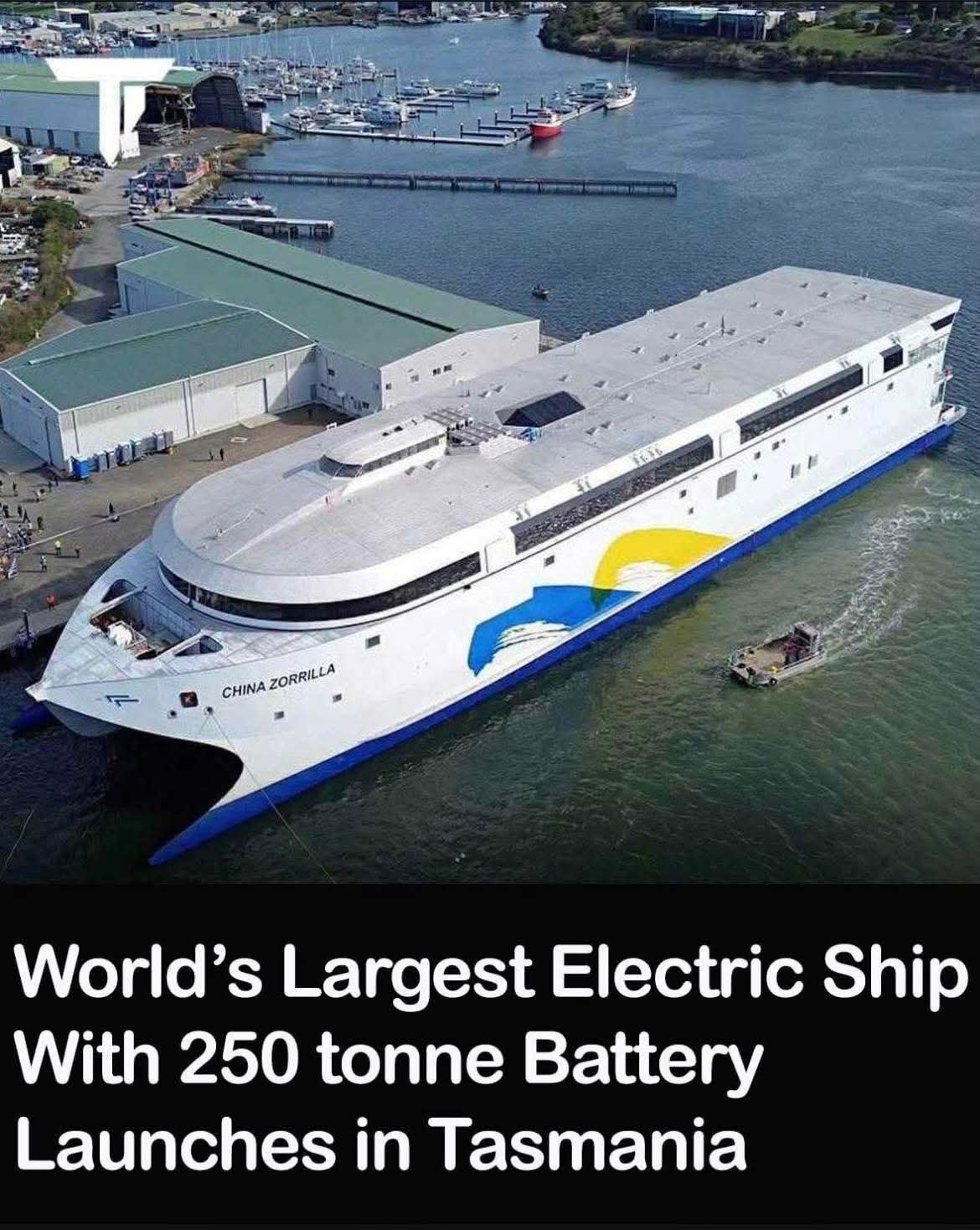
🚢⚡ AUSTRALIA MAKES MARITIME HISTORY: THE WORLD’S LARGEST BATTERY-ELECTRIC SHIP HAS ARRIVED — AND IT WAS BUILT IN TASMANIA
For decades, critics have said clean energy at scale was unrealistic. That electric transport beyond cars and buses was “years away.” That shipping — one of the world’s biggest polluters — was simply too hard to fix.
Tasmania just proved them all wrong.
Quietly, confidently, and without fanfare, Australia has launched the largest battery-electric ship ever constructed anywhere in the world. A vessel so advanced, so powerful, and so commercially viable that it doesn’t just hint at the future of maritime transport — it defines it.
This is not a prototype.
This is not a lab experiment.
This is real infrastructure, real jobs, and real climate progress, built on Australian soil and ready to sail global waters.
🌊 A GIANT OF THE ELECTRIC AGE
The 130-metre vessel, known during construction as Hull 096 and soon to be officially named China Zorrilla, represents a generational leap forward in shipbuilding.
Designed to carry:
Around 2,100 passengers
Approximately 225 vehicles
This ship rivals — and in many ways exceeds — the capabilities of traditional diesel-powered ferries. The difference?
👉 It runs entirely on electricity.
👉 It has no diesel engines.
👉 It produces zero exhaust emissions.
At a time when global shipping emits more greenhouse gases than aviation, this single ship sends a powerful message: there is another way.
🔋 THE HEART OF THE BEAST: A RECORD-BREAKING BATTERY SYSTEM
What truly sets this vessel apart lies beneath its decks.
The ship is powered by:
Over 250 tonnes of batteries
More than 40 megawatt-hours (MWh) of energy storage
The largest maritime battery system ever installed
To put that into perspective, 40 MWh is enough energy to power thousands of homes for an entire day. And here, it’s moving a 130-metre ship across open water — silently, cleanly, and efficiently.
There are:
No fuel tanks
No exhaust stacks
No oil spills waiting to happen
Just pure electric propulsion, engineered at an industrial scale once thought impossible.
⚙️ BUILT, TESTED, AND PROVEN — NOT A CONCEPT
Too often, clean-tech headlines promise “what’s coming.” This story is different.
This ship has already been: ✅ Powered up
✅ Systems tested
✅ Successfully operated on Hobart’s River Derwent
It is now preparing for final sea trials, the last step before delivery overseas to begin commercial service.
That matters.
Because it means this vessel isn’t a political talking point or a futuristic rendering — it is a working, revenue-generating asset ready to operate in real conditions.
🌍 WHY THIS SHIP CHANGES THE GLOBAL GAME
Shipping accounts for nearly 3% of global carbon emissions — roughly the same as a major industrialized nation. The industry has long relied on heavy fuel oil, one of the dirtiest energy sources on the planet.
For years, the excuse was simple:
“There’s no alternative.”
Tasmania just removed that excuse.
This ship proves:
Large electric vessels are technically viable
Battery systems can scale beyond small craft
Zero-emission shipping can compete commercially
For ferry operators, coastal transport networks, and island nations worldwide, this isn’t just impressive — it’s transformative.
🇦🇺 TASMANIA: A QUIET POWERHOUSE OF INNOVATION
There’s something poetic about where this ship was built.
Tasmania — long known for its natural beauty and renewable energy resources — is now staking its claim as a global leader in advanced clean manufacturing.
This project represents:
High-skill local jobs
World-class engineering
Export-ready Australian technology
It’s proof that innovation doesn’t have to come from Silicon Valley or Europe. Sometimes, it comes from shipyards on the River Derwent.
And when it does, the world pays attention.
💼 ECONOMIC AND STRATEGIC IMPLICATIONS
Beyond climate benefits, the implications are enormous.
Australia now has:
Proven expertise in large-scale electric shipbuilding
A competitive advantage in a fast-growing global market
A blueprint for future clean-energy exports
As nations scramble to decarbonize transport, demand for vessels like this will only grow. Ferries, short-haul shipping routes, and coastal transport corridors are all prime candidates for electrification.
The question is no longer if this technology will spread — but who will lead the expansion.
🔮 A GLIMPSE OF THE FUTURE — HAPPENING NOW
Imagine:
Ports without diesel fumes
Coastal cities with quieter, cleaner ferries
Shipping lanes that don’t poison oceans or air
That future isn’t theoretical anymore. It has a hull number, a launch date, and a country of origin.
Australia built it.
Tasmania delivered it.
The world will use it.
🔥 CALL TO ACTION: JOIN THE CONVERSATION
💬 Should battery-electric ships replace diesel ferries worldwide?
🌍 Is Australia doing enough to support clean-tech manufacturing?
⚡ What other industries could be transformed next?
👇 Share your thoughts in the comments
🔁 Share this article to challenge the “clean energy isn’t ready” myth
📢 Follow for more real-world breakthroughs shaping the future
🔗 Learn more about the project and Australian shipbuilding innovation:
[Insert official shipbuilder or project link here]


BREAKING NEWS: Do Americans Approve of Trump’s Way of Ruling? Public Opinion Splits as Debate Over His Leadership Style Resurfaces

‘WE GOT HIM!’: President Trump announced on Truth Social that U.S. forces carried out one of the most daring search-and-rescue missions in history, successfully recovering a senior officer who had been behind enemy lines in Iran.

“Andy Reid: ‘I Would Never Bet Against’ Patrick Mahomes Returning for Week 1 of 2026 Season”

Serena Williams shares a deep message for fans worldwide… Now people everywhere are reacting in a big way….

BREAKING: Trump Fires Attorney General Pam Bondi in Major Cabinet Shakeup Amid Iran War Tensions

See Serena Williams in Spicy Wet Red Barely-There Never-Before-Seen Mouth-Watering Photos: Fans Lose It When the Red Dress Couldn’t Hold Her Melons and Dropped and Revealed Her Giant…

See Serena Williams in Spicy Wet Red Barely-There Never-Before-Seen Mouth-Watering Photos: Fans Lose It When the Red Dress Couldn’t Hold Her Melons and Dropped and Revealed Her Giant…

The Goat ! Serena Williams at the vanity fair Oscar party …..

Fans have to check in : New 17 Serena Williams hot bikinis pictures
Hot Serena Williams bikini photos: 🎾 Serena Williams is embracing her new look and shutting down the noise. The tennis legend recently shared photos in bikinis

Fans Weren’t Ready for What Serena Williams Revealed While Trying on a Bikini in Her Wardrobe…