CELEBRITY
🚨 BREAKING NEWS 🚨 “Powerful and Deadly Strike” — Trump Claims U.S. Hit ISIS in Nigeria The world just got a jolt. In a dramatic post on his social media platform, President Donald Trump announced that the United States has carried out a “powerful and deadly strike” against ISIS terrorists operating in Nigeria — a group he says has been “targeting and viciously killing, primarily, innocent Christians.” This is not just another foreign policy headline. This is a statement meant to shake global attention and send a message. 🔥 WHY THIS MATTERS — RIGHT NOW Nigeria has long been battling extremist violence, particularly from ISIS-linked factions and other terror groups operating across parts of the country. These attacks have devastated communities, displaced families, and fueled global concern about religiously motivated violence. Trump’s claim signals three major things at once: ⚡ A show of force — The phrase “powerful and deadly” is deliberate. ⚡ A religious freedom framing — Highlighting Christian victims puts persecution front and center. ⚡ A warning to terror networks — The U.S. is watching, and it’s willing to act. Whether you support Trump or not, this announcement demands attention. 🌍 NIGERIA AT THE CENTER OF A GLOBAL FIGHT For years, civilians in Nigeria — Christians and Muslims alike — have been caught in the crossfire of extremist violence. Churches burned. Villages attacked. Innocent lives lost. Trump’s statement places Nigeria squarely in the global war against terrorism and raises urgent questions: Was this a single targeted strike or the start of a broader campaign? Will it reduce violence on the ground — or escalate it? How will Nigeria’s government respond? What does this mean for U.S. involvement in Africa going forward? These are not abstract issues. They affect real people, real families, and real communities. ⚠️ POLITICS, POWER, AND PERCEPTION Supporters will see this as strong leadership and decisive action — protecting persecuted Christians and confronting terrorism head-on. Critics will ask for proof, details, and accountability, questioning the timing, scope, and long-term impact of such strikes. One thing is undeniable: 👉 This post was designed to dominate the conversation. And it’s working. 💬 NOW IT’S YOUR TURN This isn’t just news — it’s a debate that deserves voices. 👉 Do you believe military strikes are the right solution to terrorism in Nigeria? 👉 Should the U.S. be more involved in protecting religious minorities abroad? 👉 Is this a necessary show of strength — or a dangerous escalation? 👇 DROP YOUR THOUGHTS IN THE COMMENTS 🔁 SHARE THIS POST to keep the conversation alive ❤️ REACT if you believe innocent lives deserve protection — anywhere in the world This story is still unfolding. Stay alert. Stay informed. Stay engaged.

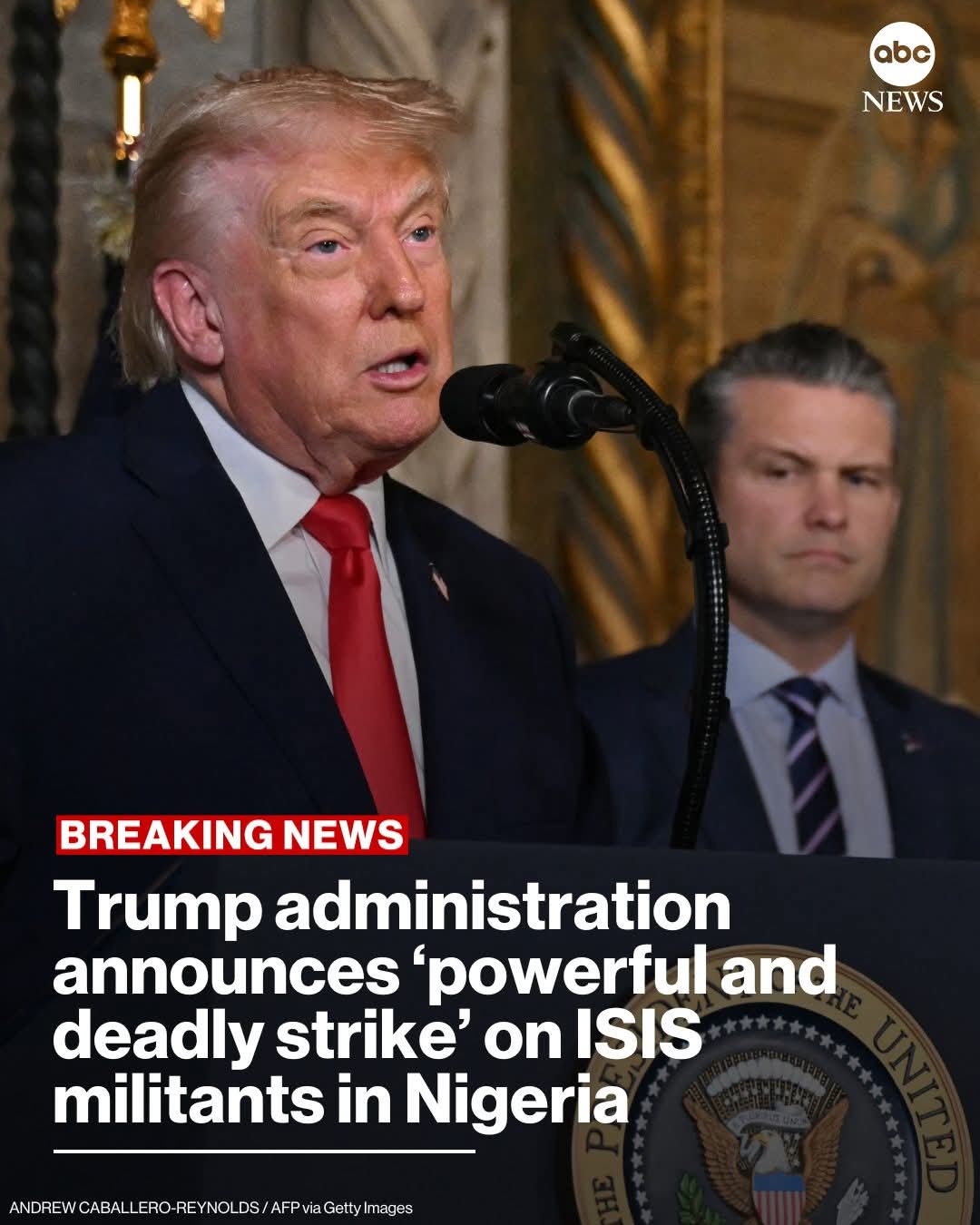
BREAKING: Trump Claims U.S. Launched “Powerful and Deadly” Strike on ISIS in Nigeria — What It Means, Why It Matters, and What Comes Next
The world’s attention snapped sharply toward West Africa after President Donald Trump announced on his social media platform that the United States had carried out a “powerful and deadly strike” against ISIS terrorists in Nigeria. According to Trump, the targeted militants had been “targeting and viciously killing, primarily, innocent Christians.”
It was a short post — but one packed with geopolitical weight, moral framing, and unmistakable intent.
Within minutes, the statement ignited fierce debate: praise from supporters who see decisive action against terrorism, skepticism from critics demanding evidence and clarity, and deep concern from observers in Nigeria who understand just how complex — and dangerous — the fight against extremist violence has become.
This is not just a headline.
It’s a flashpoint.
A REGION UNDER SIEGE: THE REALITY ON THE GROUND IN NIGERIA
Nigeria has spent more than a decade battling extremist violence. Groups aligned with ISIS and other jihadist networks operate primarily in the northeast and parts of the Middle Belt, exploiting poverty, weak governance, and long-standing communal tensions.
The human cost has been staggering:
Thousands of civilians killed
Entire villages wiped out
Churches, mosques, schools, and markets attacked
Millions displaced internally
Christians have indeed been frequent victims — particularly in rural areas where extremist groups intentionally use religious identity to terrorize communities and fracture society. But Muslims, traditional communities, and security forces have also paid a heavy price.
Trump’s framing of the strike — emphasizing the protection of Christians — taps into a powerful and emotionally charged narrative that resonates strongly with many of his supporters worldwide.
WHY TRUMP’S WORDING MATTERS
The phrase “powerful and deadly strike” is not accidental. It is designed to project strength, finality, and resolve. Trump has long favored blunt, forceful language when discussing military action — a style that bypasses diplomatic nuance in favor of raw impact.
Three strategic messages are embedded in the statement:
To ISIS and affiliated groups: The U.S. can reach you, even in regions far from traditional battlefields.
To American voters and allies: The Trump doctrine favors swift, overwhelming force over prolonged engagement.
To persecuted Christians globally: Their suffering is being recognized at the highest levels of power.
Supporters see this as moral clarity. Critics see it as oversimplification.
THE BIG QUESTION: WHAT ACTUALLY HAPPENED?
As of now, Trump’s announcement stands largely on its own. No detailed briefing, operational confirmation, or independent verification has been released publicly.
That uncertainty fuels speculation:
Was this a drone strike?
Was it coordinated with Nigerian forces?
Were specific high-value ISIS commanders targeted?
What safeguards were in place to protect civilians?
In modern warfare, information is power, and silence can be just as strategic as disclosure. But without transparency, trust erodes — especially in a region where civilian casualties can inflame resentment and create new cycles of violence.
U.S. MILITARY INVOLVEMENT IN AFRICA: A QUIET REALITY
While rarely dominating headlines, the United States has maintained a security footprint across parts of Africa for years — focused on intelligence sharing, training, and limited counterterrorism operations.
Trump’s statement, however, suggests a more direct and forceful role, even if limited in scope. That raises critical policy questions:
Is this an isolated action or the start of renewed U.S. kinetic operations in West Africa?
Will Congress be briefed or asked to authorize expanded involvement?
How does this fit into broader U.S.–Africa relations?
History shows that military strikes alone rarely defeat insurgencies. Without parallel political reform, economic development, and local legitimacy, extremist groups often regenerate.
SUPPORTERS VS. CRITICS: A SHARP DIVIDE
Trump’s supporters argue:
Terrorists understand only force
Protecting innocent lives — especially religious minorities — is a moral obligation
Delay and diplomacy have failed for years
Critics counter:
Religious framing risks inflaming sectarian conflict
Airstrikes without accountability can worsen instability
Bold claims without evidence undermine credibility
Both sides agree on one thing: terrorism in Nigeria is real, brutal, and urgent.
The disagreement lies in how best to confront it.
WHAT THIS MEANS FOR NIGERIANS
For Nigerians living under the shadow of extremist violence, foreign announcements are less important than tangible change.
They want:
Safety to worship freely
Children able to attend school without fear
Farms and markets free from terror raids
Governments — local and international — that act responsibly
A single strike, no matter how “powerful,” will not end the crisis. But it may signal renewed global attention to a conflict too often ignored.
THE GLOBAL IMPLICATIONS
Trump’s declaration also sends ripples beyond Nigeria:
To allies: The U.S. may act unilaterally if it believes moral lines have been crossed.
To adversaries: Geographic distance offers no guarantee of safety.
To international institutions: National leaders may bypass multilateral processes in favor of rapid action.
In a world already strained by war, polarization, and mistrust, such moves reshape expectations — and risks.
THE STORY IS FAR FROM OVER
Whether Trump’s claim proves accurate, exaggerated, or incomplete, it has already succeeded in one way: it forced the world to look at Nigeria again — at the bloodshed, the fear, and the unresolved struggle against extremism.
What happens next will matter far more than the words themselves.
Will violence decrease — or retaliate?
Will facts emerge — or fade into political noise?
Will global powers commit to long-term solutions — or move on?
YOUR VOICE MATTERS
This is not just a U.S. story.
This is not just a Nigerian story.
This is a human story.
👉 Do you believe military force is the right answer to terrorism in Nigeria?
👉 Should protecting religious minorities be a central goal of foreign policy?
👉 Do bold declarations help — or harm — fragile regions?
👇 JOIN THE DISCUSSION IN THE COMMENTS
🔁 SHARE THIS ARTICLE to keep global attention on Nigeria
❤️ REACT if you believe innocent lives deserve protection — everywhere
Stay informed. Stay critical. Stay engaged.


BREAKING NEWS: Do Americans Approve of Trump’s Way of Ruling? Public Opinion Splits as Debate Over His Leadership Style Resurfaces

‘WE GOT HIM!’: President Trump announced on Truth Social that U.S. forces carried out one of the most daring search-and-rescue missions in history, successfully recovering a senior officer who had been behind enemy lines in Iran.

“Andy Reid: ‘I Would Never Bet Against’ Patrick Mahomes Returning for Week 1 of 2026 Season”

Serena Williams shares a deep message for fans worldwide… Now people everywhere are reacting in a big way….

BREAKING: Trump Fires Attorney General Pam Bondi in Major Cabinet Shakeup Amid Iran War Tensions

See Serena Williams in Spicy Wet Red Barely-There Never-Before-Seen Mouth-Watering Photos: Fans Lose It When the Red Dress Couldn’t Hold Her Melons and Dropped and Revealed Her Giant…

See Serena Williams in Spicy Wet Red Barely-There Never-Before-Seen Mouth-Watering Photos: Fans Lose It When the Red Dress Couldn’t Hold Her Melons and Dropped and Revealed Her Giant…

The Goat ! Serena Williams at the vanity fair Oscar party …..

Fans have to check in : New 17 Serena Williams hot bikinis pictures
Hot Serena Williams bikini photos: 🎾 Serena Williams is embracing her new look and shutting down the noise. The tennis legend recently shared photos in bikinis

Fans Weren’t Ready for What Serena Williams Revealed While Trying on a Bikini in Her Wardrobe…