NEWS
Trump’s 100% Tariff Threat on Canada Triggers Trade War Fears, Market Jitters, and Political Firestorm as North American Economic Ties Face Renewed Uncertainty

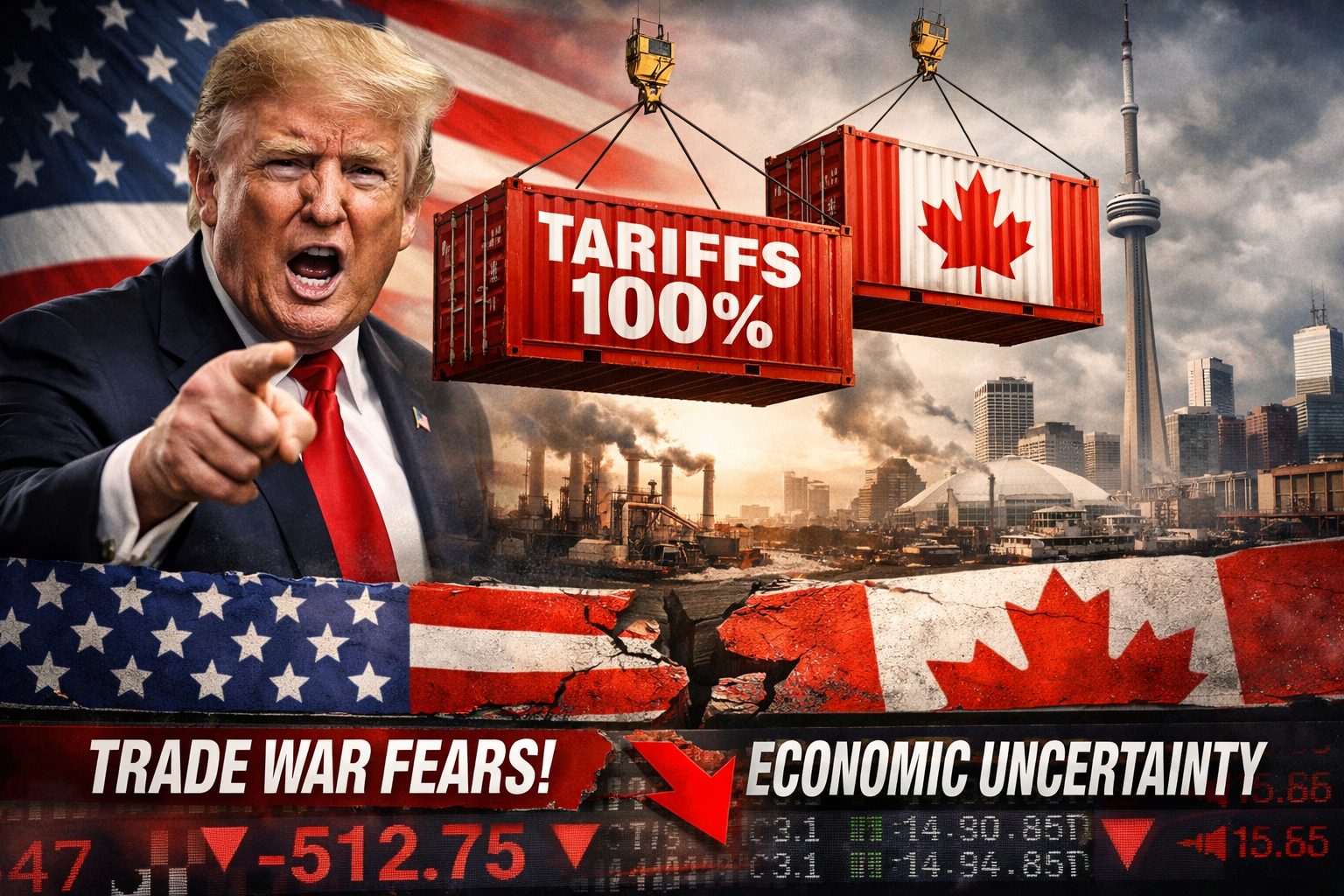
Trump’s 100% Tariff Threat on Canada Sparks Trade Shockwaves Across North America
Former U.S. President Donald Trump has ignited fresh controversy after threatening to impose 100% tariffs on Canadian imports, a move that has sent ripples through financial markets and reignited fears of a renewed North American trade war.
Speaking during a recent political appearance, Trump criticized Canada’s expanding trade relationship with China, arguing that it undermines American manufacturing and national economic security. He warned that, if returned to office—or if his influence shapes Republican trade policy—the United States would take “the strongest possible action” to protect domestic industries.
The proposed tariffs would represent one of the most aggressive trade measures ever directed at America’s closest ally. Canada is the United States’ second-largest trading partner, with hundreds of billions of dollars in goods crossing the border annually, including automobiles, energy, agricultural products, and industrial materials.
Canadian officials reacted swiftly. Senior government figures in Ottawa called the threat “reckless and economically dangerous,” warning that such tariffs would disrupt deeply integrated supply chains, drive up consumer prices, and harm workers on both sides of the border. Business groups echoed those concerns, noting that many American manufacturers rely on Canadian components to remain competitive.
In the United States, reactions were sharply divided.
Trump supporters praised the tough stance, framing it as a necessary response to what they see as unfair trade practices and growing Chinese influence in North America. “For too long, American workers have paid the price,” said one pro-Trump trade advocate. “This sends a clear message.”
Critics, however, warned that the proposal risks repeating the economic fallout of past trade battles. Economists pointed to higher costs for U.S.
consumers, potential retaliation from Canada, and instability in sectors such as automotive manufacturing and agriculture. Some analysts described the threat as a negotiating tactic rather than a concrete policy plan, designed to rally political support and pressure trading partners.
Financial markets showed signs of unease following the remarks, with trade-exposed stocks experiencing volatility as investors weighed the likelihood of escalation. Trade experts noted that any move toward such tariffs would likely face legal challenges under existing trade agreements, including the USMCA.
The episode underscores how trade remains a central pillar of Trump’s political identity. Even out of office, his rhetoric continues to shape national debate and influence global economic expectations. As North America watches closely, the tariff threat has become a flashpoint—raising urgent questions about the future of U.S.–Canada relations and the broader direction of international trade policy.
If you want, I can shorten this, make it more dramatic, or rewrite it in a viral tabloid or breaking-news style.


Fans Are Not Ready for These 7 Oiled and Drenched Serena Williams Private Beach Photos – No One Could Believe the Moment Ocean Waves Tore Her Top Off, Revealing Nothing Worn Underneath, but What Fans Could Not Stop Staring At Is the Photo of When the Waves Hit Her Backside and Shifted the Underwear Revealing a Big…

The Queen is back. A special moment as Vicky Mboko shares the court with Serena Williams at Queen’s Club. From inspiration to partnership, they’ll team up in doubles as Serena begins her long-awaited comeback journey.

Serena Williams Retires But The Court Calls Her Back Four Years Later At Age 44 The Tennis Legend Returns To Queen’s Club And Fans Everywhere Are Losing It Click the link To See Why This Comeback Has The World Talking

Serena and Simone Did What No One Thought Possible. The Last One Will Give You Chills

Serena Williams holding a bold sign: Do you still love me? Yes? Click below to check her stunning picture

Serena Williams is done with tennis, but she’s just getting started — and her next chapter might be even more powerful than her last.

Country music icons have teamed up in an unprecedented “super legend alliance” to bring back the heart, soul, and future of authentic country music.

Country music icons Willie Nelson, Dolly Parton, George Strait, Alan Jackson, Blake Shelton, Luke Bryan, and Trace Adkins have teamed up in an unprecedented “super legend alliance” to bring back the heart, soul, and future of authentic country music.

Serena Williams just broke the internet AGAIN – fans can’t stop talking and the comments are WILD. You won’t believe what has everyone obsessed. Tap to see why this post is blowing up right now – you’ll want to weigh in!

Look at 4 Serena Williams’ private video that dazzled everyone – goat Serena Williams Forgot to Turn It Off Revealing What She Does to Herself Without Underwear Before Sleeping, See Video before it is Completely gone

Serena and Venus Williams didn’t just win 30 Grand Slams—they broke barriers, changed tennis forever, and inspired millions to believe that no court, no rule, no doubt can stop a legacy built on power and sisterhood.
