NEWS
As Trump revives tariffs as a weapon, the European Union counters with long-term economic strategy, finalizing a massive Mercosur trade deal that weakens U.S. leverage, reshapes global supply chains, and proves competence beats confrontation.

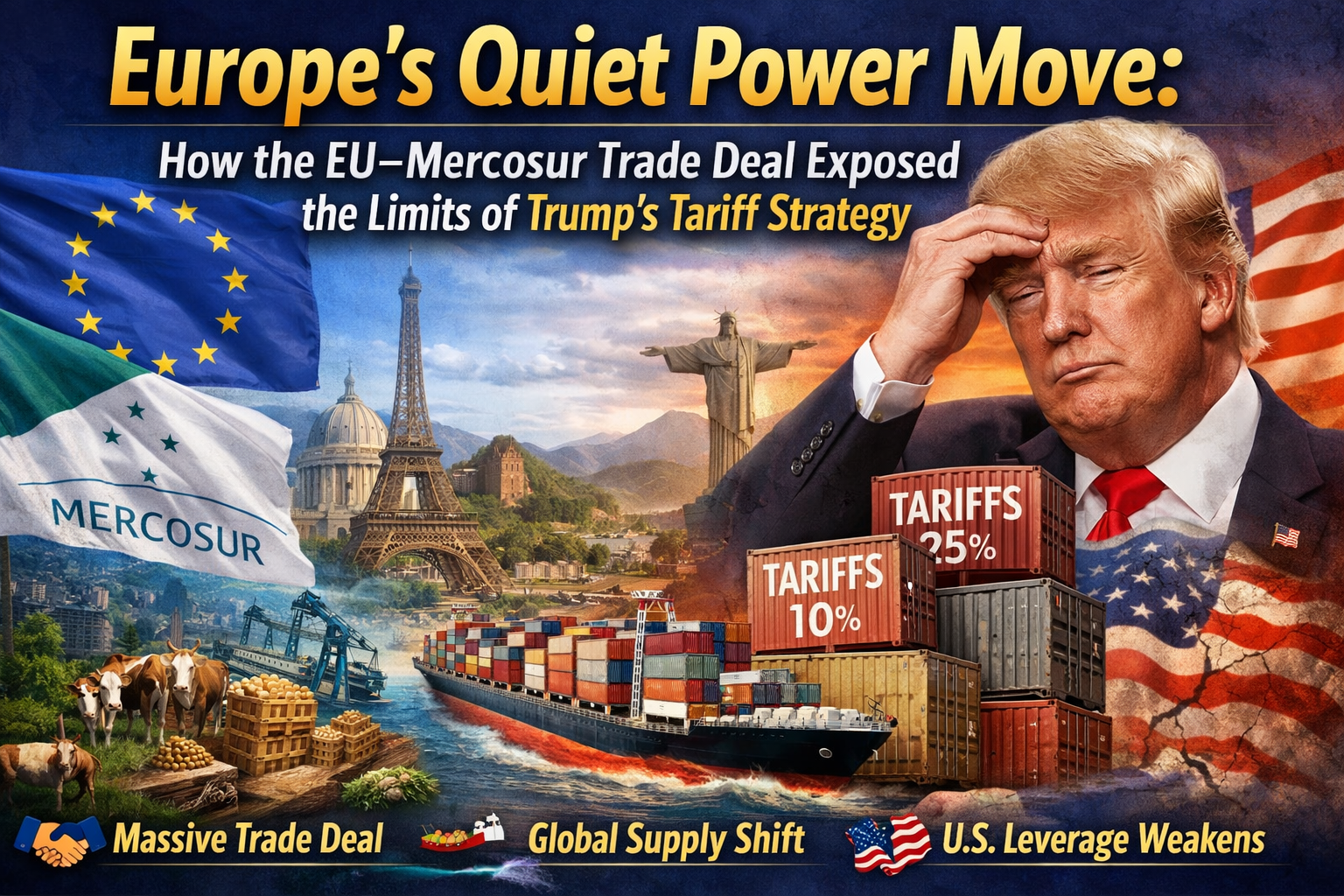
As Trump revived his familiar playbook—floating a 10% tariff here, threatening 25% tariffs there—he framed the move as strength. A warning shot. A reminder of American dominance. The targets, once again, were European allies who dared to resist U.S. pressure, whether on trade, policy alignment, or even Trump’s surreal flirtations with the idea of exerting control over Greenland.
But while Trump was busy rattling sabers, the EU did something adults in the room tend to do. They finished the job.
After more than twenty years of negotiations, Europe finalized a massive free trade agreement with Mercosur, the South American trade bloc that includes Argentina, Brazil, Paraguay, and Uruguay. No drama. No spectacle. Just a strategic realignment that quietly reshapes global trade flows.
That timing was not accidental. It was surgical.
For over two decades, the EU–Mercosur deal had stalled on environmental standards, agricultural protections, and political headwinds on both sides of the Atlantic. It survived changes in governments, economic crises, and shifting global priorities. And now—precisely as Washington leans back into tariff threats—it lands.
This is what long-term planning looks like.
The agreement links Europe to hundreds of millions of consumers and producers across South America. It opens access to enormous agricultural capacity, critical raw materials, energy resources, and fast-growing industrial demand. For Europe, it means diversified supply chains and new markets. For Mercosur countries, it means privileged access to one of the world’s largest consumer economies.
And for Trump’s tariff strategy? It means diminished leverage.
That’s the part often missed in headline-driven coverage. Tariffs don’t operate in a vacuum. They only work when the target has nowhere else to go. The moment alternatives exist—real, scalable alternatives—the threat loses its edge.
This is what tariff fatigue looks like in practice. Countries don’t retaliate loudly. They don’t escalate in public. They simply adjust. They sign new deals. They build parallel supply chains. They reduce exposure. And once that shift happens, it’s rarely reversed.
Trump’s core negotiating assumption has always been that everyone needs the United States more than the United States needs them. That assumption might have held some truth in a unipolar world. It does not hold in a multipolar one.
The EU–Mercosur deal punches directly at that belief.
With diversified access to food, energy, and manufacturing inputs from another hemisphere, Europe becomes far less sensitive to U.S. trade pressure. Tariffs that might once have stung now land with a dull thud. The cost doesn’t disappear—but it’s spread, absorbed, and mitigated.
And that exposes the fundamental weakness of tariff politics: tariffs are not a tax on foreign governments. They are a tax on domestic consumers and businesses. They raise prices at home while encouraging trading partners to look elsewhere. In the short term, they generate headlines. In the long term, they accelerate decoupling.
Europe understands this. That’s why its response wasn’t a counter-threat or a fiery press conference. It was a signature on a document years in the making.
There’s also a geopolitical message embedded here, and it’s impossible to ignore. This deal is Europe signaling that it will not be bullied—economically or politically. Not over trade. Not over policy independence. And certainly not over territory, whether Greenland or anything else.
Trump’s style thrives on spectacle. Loud demands create the illusion of dominance. But dominance without follow-through, without allies, and without adaptability quickly becomes isolation.
In contrast, the EU’s move reflects a different philosophy: resilience over bravado. Options over ultimatums. Systems over stunts.
While Trump plays checkers—reacting, escalating, and improvising—Europe plays chess with supply chains,
regulatory alignment, and long-term market access. One approach generates applause at rallies. The other reshapes the global economy.
This isn’t about symbolism. It’s about math. When the next round of tariffs hits, Europe will feel the impact—but far less than Washington expects. The pain will be diffused across a broader network of partners. The leverage Trump believes he holds will be thinner, weaker, and easier to ignore.


Fans Weren’t Ready for What Serena Williams Revealed While Trying on a Bikini in Her Wardrobe…
Fans Weren’t Ready for What Serena Williams Revealed While Trying on a Bikini in Her Wardrobe…👇

These Serena Williams New 10 Mouth-Watering Wet Beach Moment Photos in a Barely There Dress Are the New Viral Talk on the Internet, and Fans Went Crazy to See the Moment the Dress Slipped Down and What Revealed Is That Serena Has a Big…

BREAKING: U.S President Donald Trump Has Just Been Confirmed…

Internet Buzz: 10 Private Photos of Serena xWilliams Allegedly Leaked Online,

Serena Williams’ Very Soaked Hot Body in 5 Private Photos Is Causing Fans to Lose Focus – Wives and Girlfriends Complain Their Men Are Distracted and Demand the Photos Be Deleted. See Them Before They’re Removed.

It was really painful, I thought I hurt my boobs popular Instagram celebs shares pictures of her hitting her boobs on the…

These 5 private Serena Williams mouth-watering beach photos are causing serious damage to fans, see them before it deleted

5 private Serena Williams mouth-watering beach photos are causing serious damage to fans

Serena Williams shocks the internet after stepping out in an ultra-revealing outfit, igniting fierce debate, viral reactions, and headlines as fans argue fashion freedom versus public shock worldwide. See more here…

Serena William Turns Heads in a sexy white gown — The photos Are breaking the internet
