NEWS
Donald Trump’s use of Christian symbolism highlights how faith and politics intersect through signals more than decisions. These gestures matter less for intent than impact, revealing how religious imagery is used in public life—sincerely or strategically—often reflecting deep cultural and political divisions.

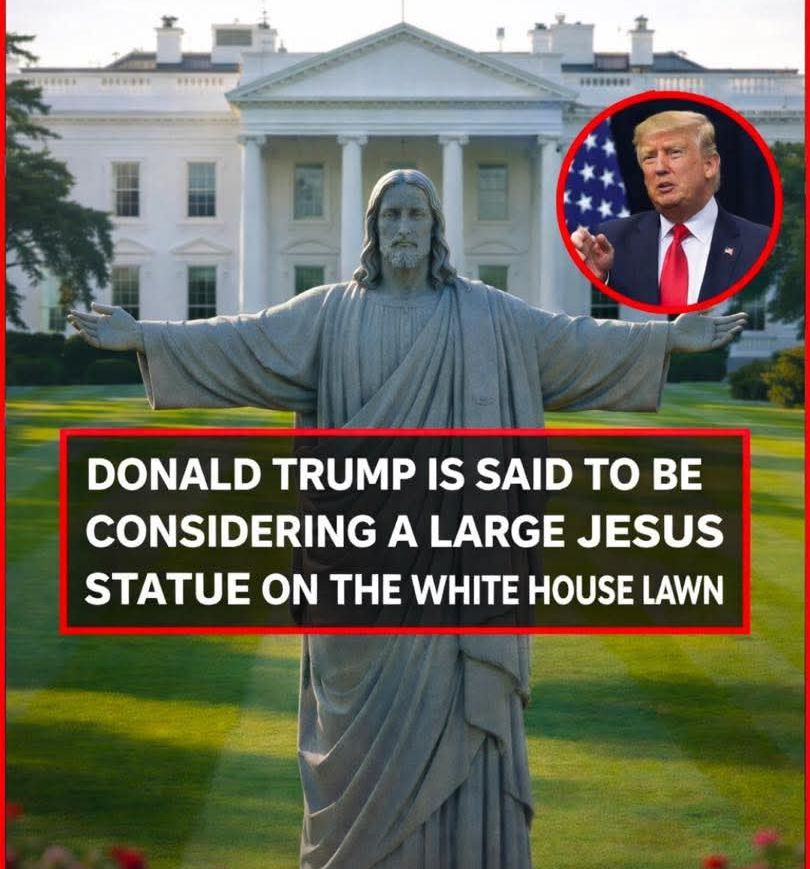
Donald Trump’s periodic alignment with Christian imagery and language has become a familiar feature of his political identity. Whether standing before churches, invoking biblical language, or entertaining symbolic gestures tied to faith, these moments consistently emerge at intersections of national identity, cultural anxiety, and political power. They are often framed carefully—not as firm decisions, but as considerations, suggestions, or rhetorical flourishes. Yet their impact frequently outweighs their formality.
What gives these moments weight is not whether a proposal materializes into action, but how effortlessly religious symbolism becomes a vessel for broader political meaning. Sacred figures and religious icons carry centuries of devotion, sacrifice, and moral authority. They are embedded deeply in personal belief systems and collective memory. Political power, by contrast, operates on immediacy—on optics, reaction cycles, and emotional resonance. When the two converge, intention becomes less important than interpretation.
For supporters, these gestures may register as affirmations of shared values. They can feel like recognition—an acknowledgment that faith still has a place in public life, that cultural traditions rooted in religion are not being erased. In this view, symbolism is not empty; it is a declaration of identity in an era where many feel their beliefs are under pressure or dismissed.
For critics, however, the same gestures appear strategic rather than spiritual. They raise concerns about the instrumentalization of belief—using faith not as a moral compass, but as a mobilizing tool. When religious symbols are introduced without clarity about purpose, permanence, or consequence, skepticism naturally follows.
Is the gesture meant to inspire unity, provoke outrage, or simply dominate the news cycle?
There is also a broader cultural dimension. In an increasingly polarized society, religion often functions as a mirror of division rather than a bridge to understanding. Symbols that once unified communities now carry different meanings depending on who invokes them and why. When political leaders engage with these symbols ambiguously, they amplify existing fractures. Faith becomes less about shared moral ground and more about signaling allegiance.
Importantly, these moments are rarely about policy. They do not outline legislation, governance strategies, or concrete outcomes. Instead, they operate in the symbolic realm, where perception shapes reality. In this space, belief is neither fully private nor fully communal—it becomes performative. The audience is not only the faithful, but the undecided, the skeptical, and the opposed.
Understanding such moments requires separating sincerity from impact. A gesture may be genuinely felt, strategically deployed, or both simultaneously. Politics does not demand purity of motive to produce consequences.
Once religious symbols enter public political spaces, they take on lives of their own, shaped by media narratives, public reaction, and historical context.
The deeper question, then, is not about one individual or one gesture. It is about how democratic societies navigate the boundary between belief and power. How can faith be respected without being weaponized? How can symbolism inspire without excluding? And how do citizens critically engage with these moments without dismissing belief itself?
When religious imagery is introduced into politics without clear intent or accountability, the responsibility shifts to the public.
Voters, observers, and institutions must ask not only what is being said, but what is being signaled—and to whom. In an era defined by symbols as much as substance, understanding that distinction has never been more important.


Fans Weren’t Ready for What Serena Williams Revealed While Trying on a Bikini in Her Wardrobe…
Fans Weren’t Ready for What Serena Williams Revealed While Trying on a Bikini in Her Wardrobe…👇

These Serena Williams New 10 Mouth-Watering Wet Beach Moment Photos in a Barely There Dress Are the New Viral Talk on the Internet, and Fans Went Crazy to See the Moment the Dress Slipped Down and What Revealed Is That Serena Has a Big…

BREAKING: U.S President Donald Trump Has Just Been Confirmed…

Internet Buzz: 10 Private Photos of Serena xWilliams Allegedly Leaked Online,

Serena Williams’ Very Soaked Hot Body in 5 Private Photos Is Causing Fans to Lose Focus – Wives and Girlfriends Complain Their Men Are Distracted and Demand the Photos Be Deleted. See Them Before They’re Removed.

It was really painful, I thought I hurt my boobs popular Instagram celebs shares pictures of her hitting her boobs on the…

These 5 private Serena Williams mouth-watering beach photos are causing serious damage to fans, see them before it deleted

5 private Serena Williams mouth-watering beach photos are causing serious damage to fans

Serena Williams shocks the internet after stepping out in an ultra-revealing outfit, igniting fierce debate, viral reactions, and headlines as fans argue fashion freedom versus public shock worldwide. See more here…

Serena William Turns Heads in a sexy white gown — The photos Are breaking the internet
