NEWS
Governor Kristi Noem harshly labeled the Minneapolis ICE shooting a case of domestic terrorism, defending an ICE agent’s use of force after a vehicle encounter during a January 7 federal operation. Her remarks, echoed by President Trump, contrast sharply with local leaders who dispute the self-defense narrative and call for transparency.

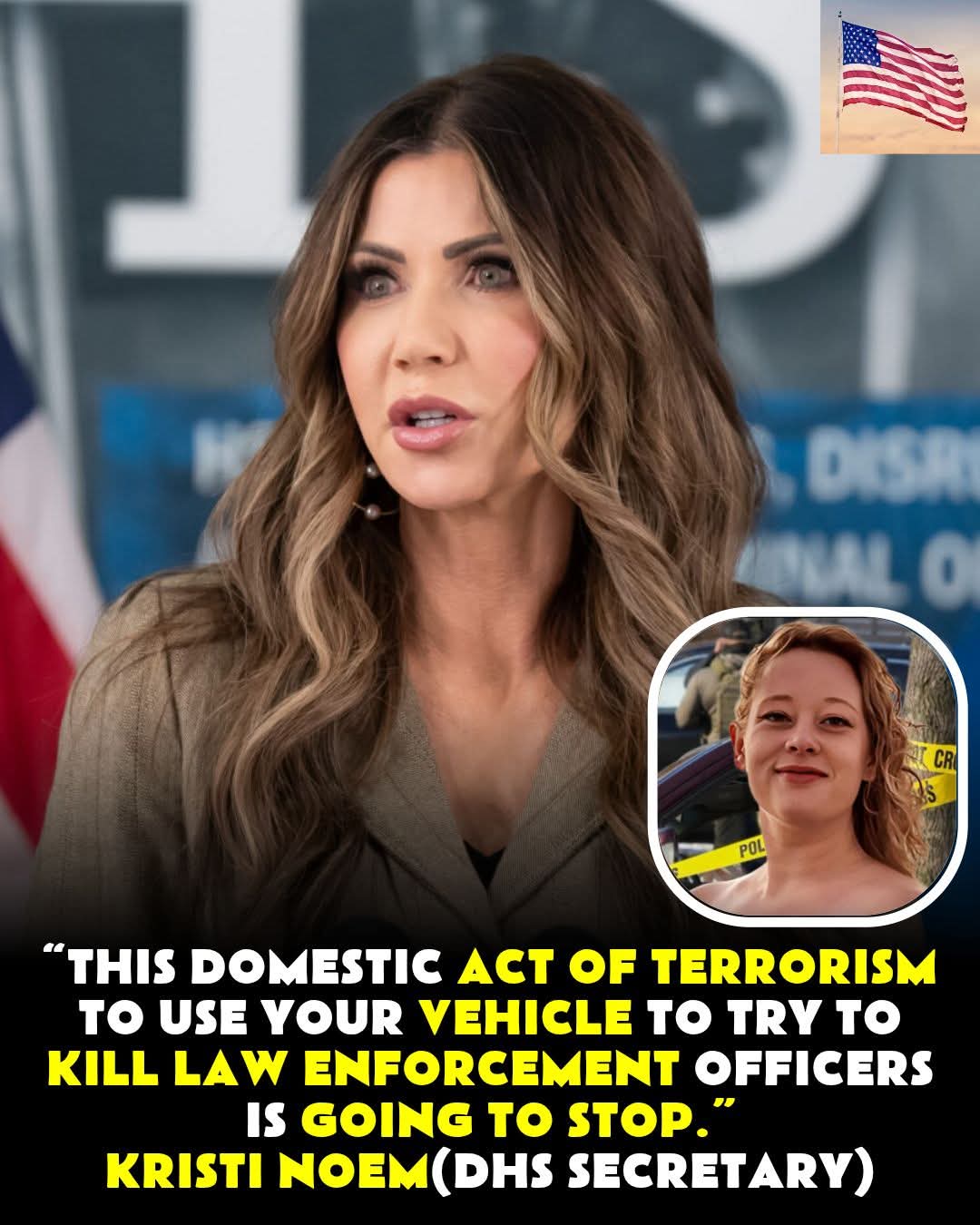
America’s simmering battle over border security and law enforcement reached a boiling point this week after a violent incident involving federal immigration agents in Minneapolis — and the political fallout has been swift, fierce, and deeply polarizing.
South Dakota Governor Kristi Noem, a close ally of President Donald Trump and a potential administration pick, did not mince words. Speaking during a January 8, 2026, joint briefing with Department of Homeland Security officials, Noem labeled the incident “domestic terrorism”, arguing that the deliberate use of a vehicle to threaten or harm federal officers represents a dangerous escalation that the nation can no longer tolerate.
“This is going to stop,” Noem declared. “With President Trump’s leadership, we are standing behind our law enforcement officers — fully, unapologetically, and without hesitation.”
The Incident That Sparked a National Firestorm
According to federal authorities, the incident occurred on January 7 as ICE agents were executing a lawful warrant in Minneapolis. Officials allege that a 37-year-old illegal entrant, reportedly connected to Minnesota’s sprawling $650 million fraud schemes, charged her vehicle toward federal agents in what they describe as an attempted act of violence.
An officer fired his weapon, an action DHS officials have characterized as justified self-defense that prevented broader harm to agents and bystanders.
However, the shooting immediately ignited controversy. Minnesota Governor Tim Walz publicly criticized the federal response and rejected offers of federal assistance, intensifying tensions between state and federal leadership. Local officials have raised questions about the incident, while federal authorities insist the threat was real and immediate.
Noem: Vehicles as Weapons Are Acts of Terror
Governor Noem framed the incident within a broader pattern of attacks against law enforcement nationwide, arguing that vehicles are increasingly being used as weapons — a tactic she says meets the definition of domestic terrorism when aimed at officers.
“When someone uses a two-ton vehicle to try to kill law enforcement,” Noem said, “that is terror. And we will call it exactly what it is.”
She credited President Trump’s administration with reversing what she described as years of erosion in officer morale and authority, pointing to a dramatic expansion in federal enforcement capacity.
“We now have more than 22,000 agents empowered, equipped, and backed by leadership that refuses to abandon them,” Noem stated.
Trump’s Law-and-Order Push
The Trump administration has highlighted several metrics to bolster its argument that tougher enforcement is working: a reported 25% drop in officer fatalities last year, record-level deportations, and aggressive operations targeting transnational criminal groups.
One such effort, Operation Hemisphere Shield, has focused on dismantling networks like Tren de Aragua, a Venezuelan-based gang the administration has labeled a major threat to U.S. communities.
Officials argue that these criminal elements flourished under previous “open-border” policies, allowing fraud, trafficking, and violence to seep into American cities.
President Trump echoed Noem’s stance in a social media post, writing:
“Kristi is 100% right! We’re stopping the terror against our GREAT law enforcement. No more!”
Despite ongoing congressional efforts to curb aspects of Trump’s foreign authority, the White House has made clear that its domestic security agenda will move forward at full speed.
A Nation Divided — and a Defining Question
Supporters argue the message is long overdue: assaults on law enforcement will be met with decisive force, and political hesitation only emboldens criminals. Critics warn that labeling disputed incidents as terrorism risks inflaming tensions and undermining public trust.
Yet for millions of Americans concerned about crime, borders, and public safety, the administration’s posture signals something unmistakable — a return to unapologetic law and order.
As arrests rise and federal operations expand, one truth defines this moment: under President Trump’s America First vision, violence against officers is not debated, negotiated, or excused.
It is stopped.
What do YOU think?
Was this a justified act of self-defense — or a dangerous escalation?
Should attacks involving vehicles be treated as domestic terrorism?
👉 Share this . Join the debate. Make your voice heard.


BREAKING NEWS: Do Americans Approve of Trump’s Way of Ruling? Public Opinion Splits as Debate Over His Leadership Style Resurfaces

‘WE GOT HIM!’: President Trump announced on Truth Social that U.S. forces carried out one of the most daring search-and-rescue missions in history, successfully recovering a senior officer who had been behind enemy lines in Iran.

“Andy Reid: ‘I Would Never Bet Against’ Patrick Mahomes Returning for Week 1 of 2026 Season”

Serena Williams shares a deep message for fans worldwide… Now people everywhere are reacting in a big way….

BREAKING: Trump Fires Attorney General Pam Bondi in Major Cabinet Shakeup Amid Iran War Tensions

See Serena Williams in Spicy Wet Red Barely-There Never-Before-Seen Mouth-Watering Photos: Fans Lose It When the Red Dress Couldn’t Hold Her Melons and Dropped and Revealed Her Giant…

See Serena Williams in Spicy Wet Red Barely-There Never-Before-Seen Mouth-Watering Photos: Fans Lose It When the Red Dress Couldn’t Hold Her Melons and Dropped and Revealed Her Giant…

The Goat ! Serena Williams at the vanity fair Oscar party …..

Fans have to check in : New 17 Serena Williams hot bikinis pictures
Hot Serena Williams bikini photos: 🎾 Serena Williams is embracing her new look and shutting down the noise. The tennis legend recently shared photos in bikinis

Fans Weren’t Ready for What Serena Williams Revealed While Trying on a Bikini in Her Wardrobe…