NEWS
Taylor Swift and Lady Gaga have said they will not perform at future White House events if invited, a decision that has quickly sparked conversation across social media

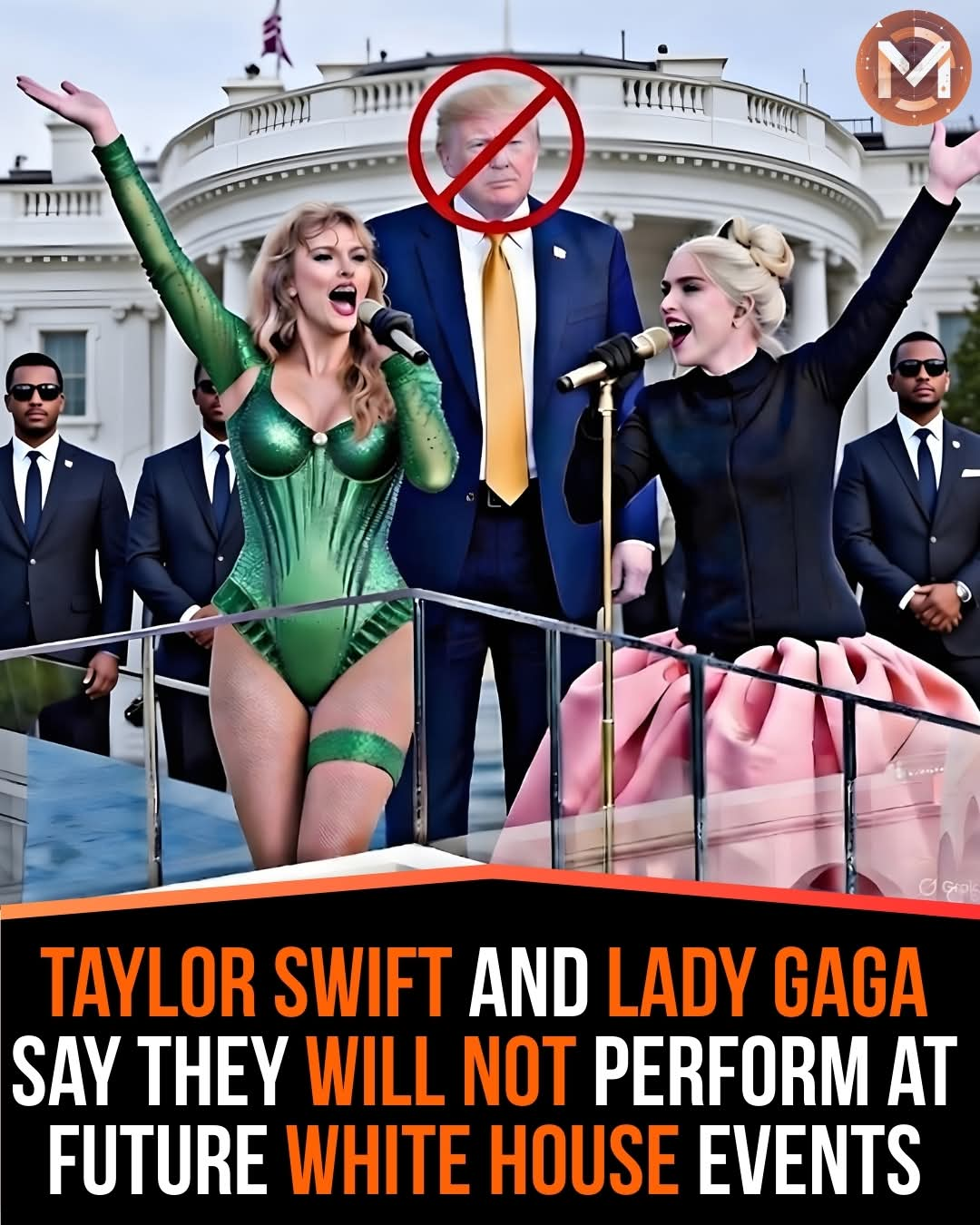
When Pop Meets Power: Taylor Swift, Lady Gaga, and the Politics of Saying No
In an era where celebrity influence rivals that of traditional institutions, Taylor Swift and Lady Gaga have once again placed themselves at the center of a national conversation. Their reported decision to decline future invitations to perform at White House events has ignited widespread debate—not just about their personal choices, but about the evolving role of entertainers in political and cultural life.
For supporters, the move is being celebrated as a principled stand. Swift and Gaga have long been vocal about social issues, personal values, and the causes they support. To many fans, declining a White House performance is not an act of disrespect, but a deliberate expression of conscience. In a time when silence itself is often interpreted as a political statement, choosing not to perform becomes, for them, a form of speech.
Critics, however, see the issue differently. They argue that the White House is meant to represent the nation as a whole, transcending party lines and political disagreements
From this perspective, entertainers refusing invitations risk turning cultural moments into partisan symbols. Some question whether artists—whose fame is rooted in entertainment rather than public service—should wield their influence in ways that shape political discourse.
The reaction on social media has been swift and polarized. Fans praise the artists for “standing firm” and “putting values over visibility,” while detractors accuse them of alienating audiences or blurring the line between art and activism.
The debate has spilled into talk shows, opinion columns, and comment sections, reflecting a broader cultural tension: how much power should celebrities have, and how should they use it?
What makes this moment particularly significant is that it is not isolated. In recent years, musicians, actors, and athletes have increasingly taken public stands on political and social issues—sometimes at personal or professional cost.
Award speeches, concert stages, and social media platforms have become arenas for activism. For better or worse, celebrities are no longer expected to “just entertain.” Many fans now look to them as moral voices, while others long for a return to escapism.
By declining potential White House performances, Swift and Gaga underscore how deeply intertwined entertainment and politics have become.
Their decision highlights a shifting cultural expectation: that public figures must navigate not only their craft, but the political implications of every high-profile appearance.
Ultimately, the controversy says as much about the audience as it does about the artists. It reflects a society grappling with division, influence, and the meaning of public platforms. Whether viewed as courageous, controversial, or unnecessary, the choice made by Swift and Gaga has reignited an important question for our time: in a highly charged public landscape, is staying neutral still possible—or is every choice, including saying no, a political act?
As the debate continues, one thing is clear: when pop icons draw boundaries, the conversation doesn’t stay on the stage. It echoes across culture, politics, and the public square—forcing us all to confront where we stand.


BREAKING NEWS: Do Americans Approve of Trump’s Way of Ruling? Public Opinion Splits as Debate Over His Leadership Style Resurfaces

‘WE GOT HIM!’: President Trump announced on Truth Social that U.S. forces carried out one of the most daring search-and-rescue missions in history, successfully recovering a senior officer who had been behind enemy lines in Iran.

“Andy Reid: ‘I Would Never Bet Against’ Patrick Mahomes Returning for Week 1 of 2026 Season”

Serena Williams shares a deep message for fans worldwide… Now people everywhere are reacting in a big way….

BREAKING: Trump Fires Attorney General Pam Bondi in Major Cabinet Shakeup Amid Iran War Tensions

See Serena Williams in Spicy Wet Red Barely-There Never-Before-Seen Mouth-Watering Photos: Fans Lose It When the Red Dress Couldn’t Hold Her Melons and Dropped and Revealed Her Giant…

See Serena Williams in Spicy Wet Red Barely-There Never-Before-Seen Mouth-Watering Photos: Fans Lose It When the Red Dress Couldn’t Hold Her Melons and Dropped and Revealed Her Giant…

The Goat ! Serena Williams at the vanity fair Oscar party …..

Fans have to check in : New 17 Serena Williams hot bikinis pictures
Hot Serena Williams bikini photos: 🎾 Serena Williams is embracing her new look and shutting down the noise. The tennis legend recently shared photos in bikinis

Fans Weren’t Ready for What Serena Williams Revealed While Trying on a Bikini in Her Wardrobe…