NEWS
Trump says he has fully terminated Biden executive actions signed by autopen, arguing they were unauthorized and claiming decisions shaping the nation must be personally approved by the president, not mechanically signed by a device.

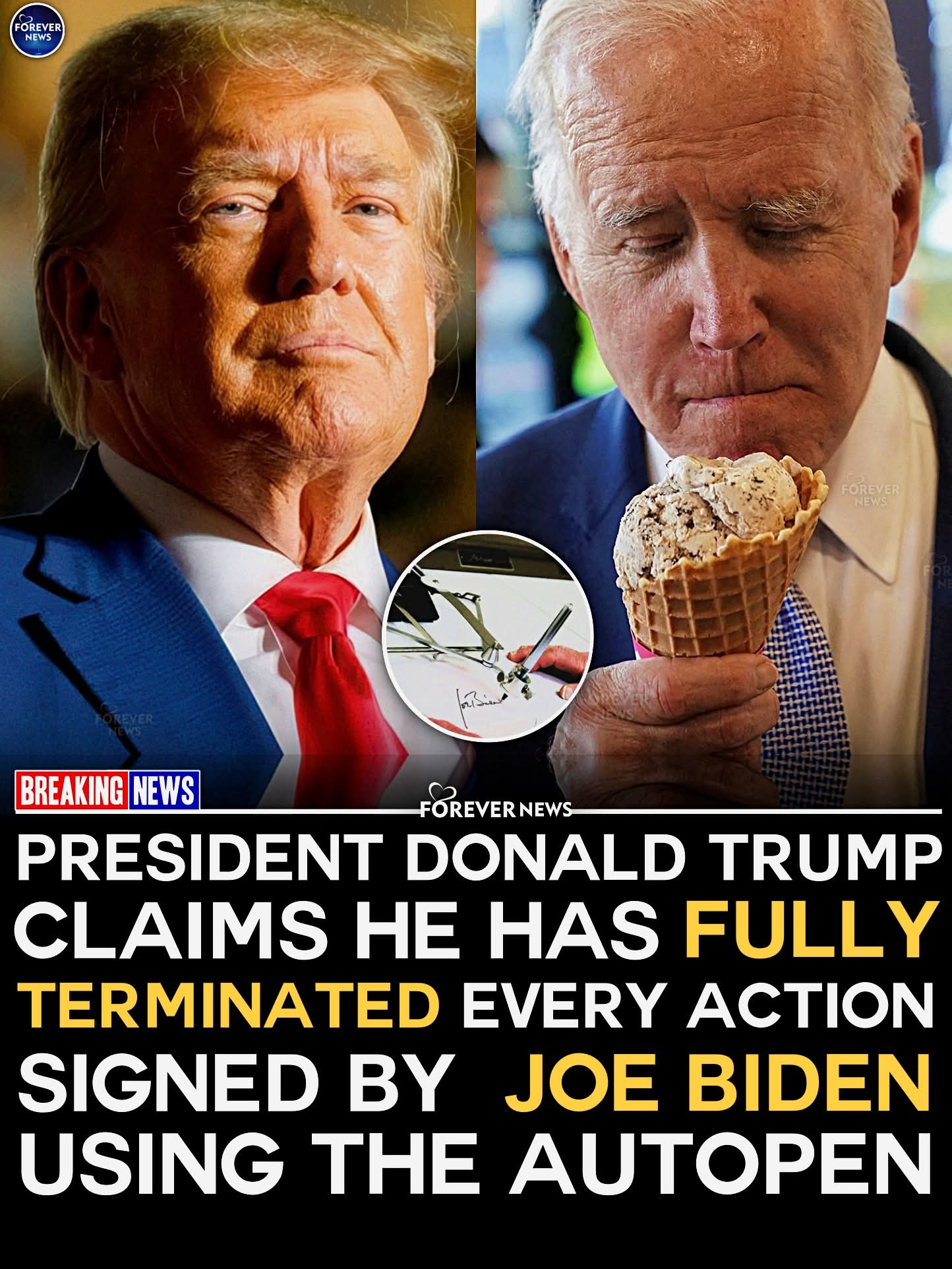
Former President Donald Trump has ignited a fresh political and legal controversy after announcing that he has “fully terminated” a series of executive actions signed by President Joe Biden using an autopen—a mechanical device that reproduces a person’s signature. Trump argues that such actions were “unauthorized,” asserting that decisions with national consequences must be personally reviewed and approved by the president, not signed by a machine.
In a statement, Trump framed the issue as one of accountability and constitutional responsibility. According to him, the use of an autopen undermines the seriousness of executive authority and raises questions about who was truly making decisions inside the White House. “The American people deserve to know that the president himself approved actions that affect their lives,” Trump said, emphasizing that executive power should not be delegated to a device.
The claim has quickly polarized political observers. Supporters of Trump argue that the use of an autopen symbolizes a lack of transparency and fuels concerns about presidential capacity and staff-driven governance. They contend that if a president is unable or unwilling to personally sign executive actions, it raises legitimate doubts about leadership and consent. For them, Trump’s move is portrayed as a necessary step to restore integrity and personal responsibility to the office of the presidency.
Critics, however, push back strongly. Legal scholars note that the autopen has been used by multiple presidents of both parties for decades, including Barack Obama and George W. Bush, particularly when the president was traveling. Courts and the Department of Justice have generally accepted that an autopen signature, when authorized by the president, carries the same legal weight as a handwritten one. From this perspective, Trump’s claim to “terminate” Biden-era actions signed by autopen is seen as more political theater than enforceable policy.
Constitutional experts also point out that a former president does not have unilateral authority to void executive actions taken by a sitting or subsequent president. Even if Trump were to return to office, rescinding prior executive orders would typically require issuing new orders, following established legal procedures, and in some cases facing judicial review.
The controversy nonetheless taps into broader concerns about executive power, transparency, and trust in government. It also feeds into ongoing partisan debates about Biden’s leadership style and the influence of unelected advisors within the executive branch.
For Trump, the issue aligns with his broader campaign narrative that promises to dismantle what he describes as a broken and unaccountable system in Washington.
As the debate continues, one thing is clear: the question is no longer just about a signature device.
It is about how Americans view presidential authority, accountability, and the legitimacy of decisions made at the highest level of government. Whether Trump’s claim has legal standing or not, it has succeeded in reigniting a national conversation about who truly holds the pen of power in the White House.


BREAKING NEWS: Do Americans Approve of Trump’s Way of Ruling? Public Opinion Splits as Debate Over His Leadership Style Resurfaces

‘WE GOT HIM!’: President Trump announced on Truth Social that U.S. forces carried out one of the most daring search-and-rescue missions in history, successfully recovering a senior officer who had been behind enemy lines in Iran.

“Andy Reid: ‘I Would Never Bet Against’ Patrick Mahomes Returning for Week 1 of 2026 Season”

Serena Williams shares a deep message for fans worldwide… Now people everywhere are reacting in a big way….

BREAKING: Trump Fires Attorney General Pam Bondi in Major Cabinet Shakeup Amid Iran War Tensions

See Serena Williams in Spicy Wet Red Barely-There Never-Before-Seen Mouth-Watering Photos: Fans Lose It When the Red Dress Couldn’t Hold Her Melons and Dropped and Revealed Her Giant…

See Serena Williams in Spicy Wet Red Barely-There Never-Before-Seen Mouth-Watering Photos: Fans Lose It When the Red Dress Couldn’t Hold Her Melons and Dropped and Revealed Her Giant…

The Goat ! Serena Williams at the vanity fair Oscar party …..

Fans have to check in : New 17 Serena Williams hot bikinis pictures
Hot Serena Williams bikini photos: 🎾 Serena Williams is embracing her new look and shutting down the noise. The tennis legend recently shared photos in bikinis

Fans Weren’t Ready for What Serena Williams Revealed While Trying on a Bikini in Her Wardrobe…