NEWS
Trump’s $1.5 Trillion Defense Gamble: How a Historic Military Spending Surge Forces China Into an Unwinnable Economic and Strategic Choice, Reviving Cold War–Style Pressure Without Firing a Shot

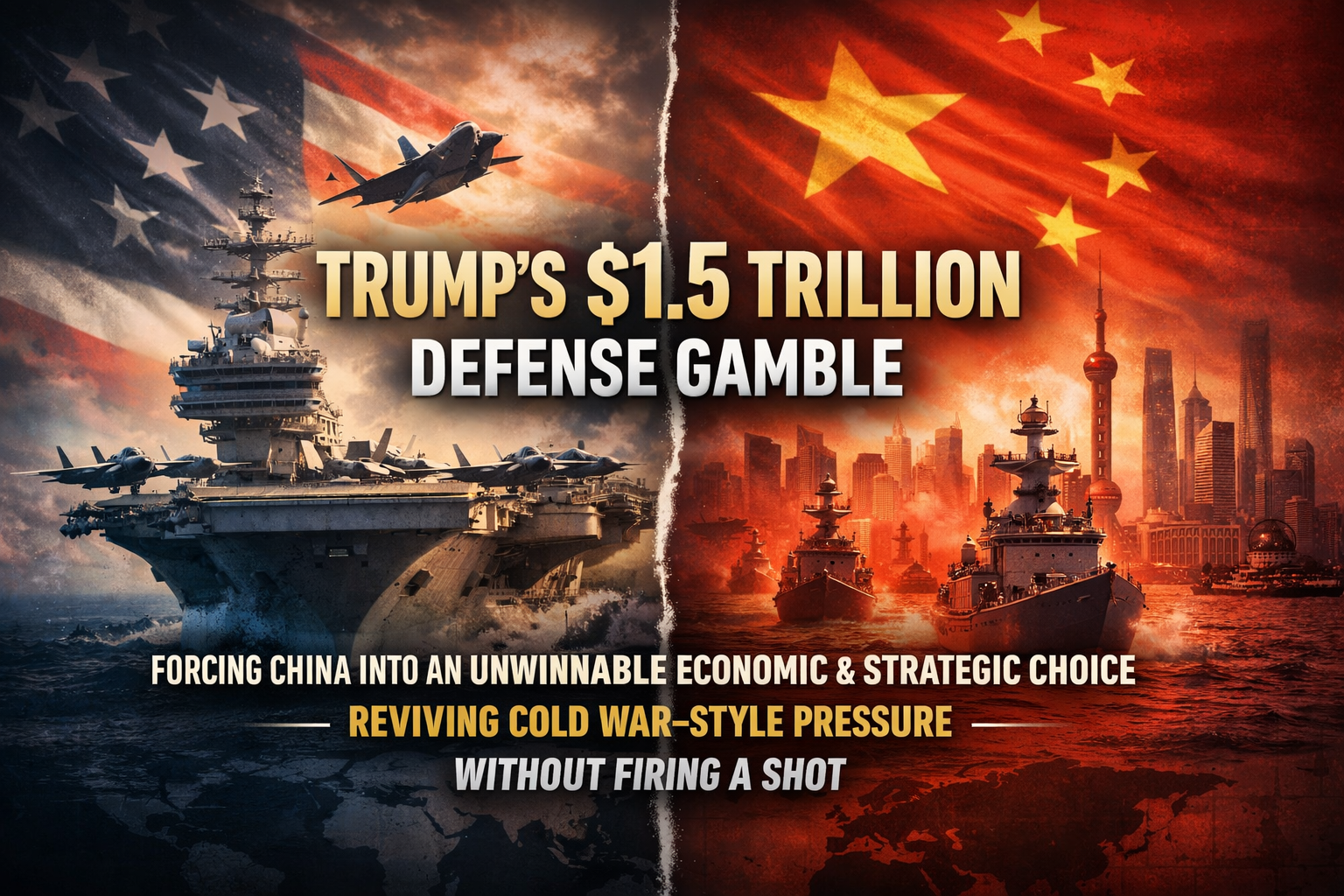
President Donald Trump just signaled one of the most aggressive strategic moves of the modern era: raising U.S. defense spending to $1.5 trillion by 2027, roughly 5% of U.S. GDP. On its face, it looks like a budget announcement. In reality, it’s a geopolitical move designed to force a choice that China cannot win.
This isn’t about Russia. Russia’s economy can’t sustain a peer competition at this scale, and Trump knows it. The message is aimed squarely at Beijing, which has spent the last decade positioning itself as America’s equal—militarily, technologically, and economically. That claim now comes with a bill.
The playbook should feel familiar. In the 1980s, Ronald Reagan forced the Soviet Union into an arms race it could not afford. The USSR tried to keep pace with U.S. spending and technological leaps until the economic strain became fatal. The collapse didn’t come from a battlefield loss. It came from financial exhaustion.
Trump is reviving that strategy—scaled for a new era.
Beijing now faces a dead-end choice. If China tries to match U.S. spending, it must dramatically increase military outlays at a moment when its economy is already under pressure from slowing growth, a faltering real estate sector, youth unemployment, capital flight, and demographic decline. Mirroring a $1.5 trillion U.S. defense budget would put crushing stress on China’s domestic economy.
If China doesn’t match it, the consequences are different but no less severe: falling behind in advanced systems, losing deterrence credibility, weakening alliances, and suffering a loss of global prestige. For a regime that relies heavily on projecting strength, that kind of reputational damage is politically dangerous.
Either path leads to loss. That’s the trap.
Chinese leadership understands this history. They know how the Soviet story ended, and they know modern warfare is even more expensive—AI, space assets, hypersonics, cyber capabilities, and naval expansion all demand sustained, massive investment. This isn’t a short contest. It’s a long-duration test of economic endurance.The United States can fund it. China likely cannot—without breaking itself.
.
Trump sharpened the move by tying the increase to tariff revenue, reframing the surge not as reckless expansion but as strategic reinvestment funded by foreign trade pressure. It’s not just a defense budget. It’s an instrument of economic warfare designed to outlast a rival without firing a shot.That’s how the Cold War ended the first time. And it’s why Beijing is watching this decision with real alarm.


BREAKING NEWS: Do Americans Approve of Trump’s Way of Ruling? Public Opinion Splits as Debate Over His Leadership Style Resurfaces

‘WE GOT HIM!’: President Trump announced on Truth Social that U.S. forces carried out one of the most daring search-and-rescue missions in history, successfully recovering a senior officer who had been behind enemy lines in Iran.

“Andy Reid: ‘I Would Never Bet Against’ Patrick Mahomes Returning for Week 1 of 2026 Season”

Serena Williams shares a deep message for fans worldwide… Now people everywhere are reacting in a big way….

BREAKING: Trump Fires Attorney General Pam Bondi in Major Cabinet Shakeup Amid Iran War Tensions

See Serena Williams in Spicy Wet Red Barely-There Never-Before-Seen Mouth-Watering Photos: Fans Lose It When the Red Dress Couldn’t Hold Her Melons and Dropped and Revealed Her Giant…

See Serena Williams in Spicy Wet Red Barely-There Never-Before-Seen Mouth-Watering Photos: Fans Lose It When the Red Dress Couldn’t Hold Her Melons and Dropped and Revealed Her Giant…

The Goat ! Serena Williams at the vanity fair Oscar party …..

Fans have to check in : New 17 Serena Williams hot bikinis pictures
Hot Serena Williams bikini photos: 🎾 Serena Williams is embracing her new look and shutting down the noise. The tennis legend recently shared photos in bikinis

Fans Weren’t Ready for What Serena Williams Revealed While Trying on a Bikini in Her Wardrobe…