NEWS
BREAKING: US President Donald Trump says we have eliminated Iran’s navy and its planes.

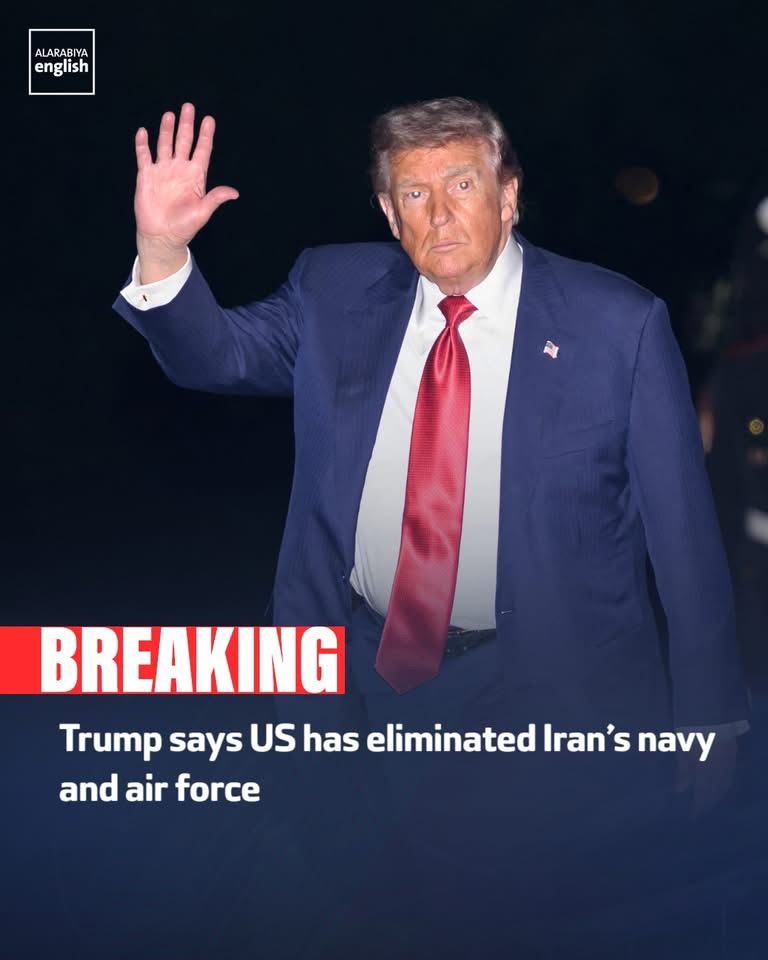
**🔴 BREAKING: Decisive Victory in the Gulf — President Donald Trump Announces the Elimination of Iran’s Navy and Air Force Capabilities** 🚨
In one of the most significant military developments in the Middle East in decades, President Donald J. Trump has declared that United States forces, in coordination with allied operations, have effectively dismantled Iran’s naval fleet and severely degraded its air capabilities. The announcement marks a pivotal turning point in the ongoing tensions and recent conflict involving Iran, following what the White House has described as Operation Epic Fury — a swift, precision-focused campaign aimed at neutralizing immediate threats to global shipping, energy security, and regional stability.
Speaking during a recent address, President Trump left no room for ambiguity. “They have no navy. They have no air force. They have no anti-aircraft equipment,” he stated emphatically. Trump highlighted the destruction of approximately 158 Iranian vessels, ranging from larger warships to support craft, asserting that the Islamic Republic’s ability to project power across the vital Strait of Hormuz has been crippled.
This comes amid a U.S.-enforced naval blockade of Iranian ports and intensified operations to secure the Strait of Hormuz, the chokepoint through which roughly 20% of the world’s oil supply passes. Trump warned that any remaining “fast attack ships” approaching U.S. forces or the blockade would be “immediately eliminated,” drawing parallels to tactics used against drug-running vessels in other theaters.12
Tensions with Iran have simmered for years, fueled by its nuclear ambitions, support for proxy militias across the region, attacks on international shipping, and ballistic missile programs. The situation escalated dramatically in early 2026, prompting a decisive U.S. and allied response.Operation Epic Fury, launched under direct presidential directive, set clear objectives: destroy Iran’s ballistic missile and drone capabilities, obliterate its navy, and dismantle its defense industrial base to prevent power projection beyond its borders. In just 38 days of major combat operations, U.S. forces achieved these goals with overwhelming precision.20
Key statistics from the operation paint a picture of American military dominance:- Over 10,200 total air sorties flown.
– More than 13,000 targets struck, including command centers, air defense systems, drone facilities, and naval assets.
– Nearly 150 warships across 16 classes destroyed.
– Every known Iranian submarine sunk.
– 97% of naval mines eliminated.20
U.S. naval assets, including destroyers and carrier strike groups, played a central role in the maritime domain. Precision strikes from aircraft like F/A-18 Super Hornets targeted Iranian vessels, while advanced air and missile defense systems neutralized inbound threats. Israeli forces reportedly contributed to strikes on related targets, showcasing strong allied coordination.13
Iran’s navy, once a mix of aging frigates, fast-attack boats, and submarines acquired or built with asymmetric warfare in mind, has been largely sent to the bottom of the Gulf. Larger surface combatants were prioritized in initial strikes, followed by systematic targeting of ports, maintenance facilities, and mine-laying capabilities.While some small, agile fast-attack craft remain, Trump and Pentagon officials have downplayed their strategic value in the face of U.S. naval superiority. Iran’s air force — hampered for years by sanctions limiting spare parts and modern upgrades — suffered similar setbacks. Air defense networks, radar installations, and runways were heavily degraded, limiting any ability to contest airspace.11
Tehran has issued defiant statements, claiming successful counterattacks and vowing retaliation. However, independent assessments and satellite imagery appear to corroborate significant damage to Iranian military infrastructure. Recent exchanges in the Strait of Hormuz, including Iranian attempts to target U.S. destroyers with missiles and drones, were met with swift U.S. self-defense strikes on launch sites and command nodes.2
The disruption in the Strait of Hormuz sent shockwaves through global energy markets. Oil prices spiked as shipping companies rerouted vessels and insurance premiums soared. The U.S. blockade and subsequent “guidance” of trapped civilian ships aim to restore safe passage without Iranian interference or illegal tolls.17Positive notes for the U.S. economy emerged despite the conflict. Trump noted record stock market highs even during the operation, crediting strong domestic fundamentals and the necessity of the action to prevent a nuclear-armed Iran. “We stopped them from getting a nuclear weapon — probably within a month,” he remarked.11
Internationally, reactions have been mixed. Allies praised the restoration of deterrence and freedom of navigation. Critics, including some in Europe and at the United Nations, called for de-escalation and diplomacy. China, a major buyer of Iranian oil, has expressed concerns, with upcoming talks between President Trump and President Xi Jinping expected to address broader regional stability.1This campaign embodies the “Peace Through Strength” doctrine. By demonstrating overwhelming capability and willingness to act, the U.S. has altered the calculus for adversaries. Military analysts highlight several lessons
President Trump has framed the outcome as a historic win for America and the world. “We did what had to be done. Nobody else would,” he said.The Middle East enters a new, uncertain chapter. Iran’s conventional naval and air threats have been neutralized for now, but the underlying geopolitical rivalries persist. Global markets, regional governments, and everyday citizens will be watching closely as negotiations unfold.


“BREAKING: Taylor Swift & Travis Kelce Secretly Married Before $30M MSG Wedding — See Her New Ring + All The Photos”

Travis Kelce Broke Down Reading His Vows. The 2 Words Taylor Whispered Back Broke Everyone”

SERENA WILLIAMS JUST REVEALED A VIDEO OF WHAT SHE’S BEEN KEEPING PRIVATE FOR YEARS… AND IT’S EVERYTHING watch the video now before it gone

IT’S FINALLY OFFICIAL! Hearts Are Overflowing with Joy! Travis Kelce and Taylor Swift just stunned the world with a major announcement during the latest public appearance. The speculation is officially OVER, and the news is even more beautiful than anyone could have ever imagined!

Taylor Swift and Travis Kelce Are Officially Married! Taylor Swift and Travis Kelce tied the knot at Madison Square Garden in New York City on July 3

SERENA WILLIAMS JUST REVEALED WHAT SHE’S BEEN KEEPING PRIVATE FOR YEARS… AND IT’S EVERYTHING

Serena Williams finally show up what she has been keeping private body to everyone…..

Serena Williams Breaks Silence: How Gruelling, Invasive Doping Protocols Nearly Destroyed Her Confidence And Almost Forced Her To Quit Tennis For Good

Trump Kisses Mystery Woman LIVE at World Cup Draw… Melania’s Face Says It All during the 2026 World Cup Draw —— furious melania felling BETRAYED – RETALIATES by EXPOSING TRUMP SECRET

Internet Buzz: 3 hot Private Photos of Serena Williams Allegedly Leaked Online,click to see ..see more

Serena Williams Just Stepped Out in a Look That’s Got Everyone Talking – See Why Fans Are Calling It Pure Confidence
